Dear RIT Faculty, Students, Staff and Friends of the Caroline Werner Gannett Project:
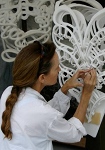
As of May 2, 2012, MacArthur award-winning sculptor Elizabeth Turk brought to an end six years of our flagship RIT series, “Visionaries in Motion.” In the weeks since, many of you have sought us out, incredulous that the talks and events that brought RIT such acclaim are over.
First and most important, thanks to all of you for making this unique series such a success. You welcomed our scientists, artists, scholars and thinkers who work at the cusp of several disciplines, and who think deeply about such important matters as climate change, global industrial waste, artificial intelligence, digital medicine, green architecture, graphic art and human-computer interaction. You supported us in record numbers (average: 300 per talk), engaged in memorable dialogue with our “visionary” speakers, as did alums, other faculty, students and community members from the wider Rochester area. Over many years you listened to lively interviews with our speakers and Bob Smith, host of WXXI's 1370 Connection. We are proud to have been chosen Best Lecture Series in Rochester by City newspaper in 2009.
Who were some of these visionaries who inspired all of us to think in bold new multidisciplinary ways? Fourteen RIT classes accepted graphic designer Stefan Sagmeister's challenge to “Touch Someone's Heart with Design,” creating imaginative projects that filled RIT's campus. Elizabeth Streb presented images of her dancer-athletes (Streb Lab for Action Mechanics) in a breathtaking weave of physics, mathematics, dance and design. Revolutionary futurist and AI expert Ray Kurzweil demonstrated a new piece of technology to 1,400 people in the Gordon Field House. John Maeda, founder of MIT's Simplicity Consortium and new president of RISD, brought crowds to his talk on “Humanity, Simplicity and Technology.” Syndicated comic strip artist Lynda Barry excited audiences with her “Writing the Unthinkable” talk and workshop. Behavioral economist Dan Ariely charmed us with “Who Put the Monkey in the Driver's Seat?” Janna Levin, physicist, cosmologist and PEN award winner, asked “Is the Universe Infinite?” World-renowned photographer Ed Burtynsky explored landscape transformed by the oil industry. Environmental activist Bill McKibben held colloquia and spoke on “Uniting Global and Local.” Whimsical author, illustrator and product designer Maira Kalman discussed “Just Looking,” while Jeanne Gang, MacArthur award-winning architect and designer of Chicago's famed Aqua Tower, spoke on “Assembly as Medium.” The Flying Words Project brought down the house with performance poetry from deaf and hearing perspectives. Dr. Lee Hood talked to an overflow house about “Systems Biology and Systems Medicine.” Alison Bechdel gave a rare look at the craft of creating her novels and cartoons. Golan Levin discussed interactive art and human-computer interaction to another sellout crowd. Chimamanda Ngozi Adichie, another MacArthur award winner, held us captive with her powerful storytelling.
And these speakers are only a sampling! Crowds grew well beyond the boundaries of RIT, mingling alums, groups of Rochester professionals, and faculty and student groups from Utica, Buffalo, Syracuse and various area colleges. All events were free and open to the public.
Netting these individuals was only part of the mission. Complementing the many TED-ers, MacArthur and other award-winning speakers, we brought a wide range of creative experiences to RIT — hands-on workshops, colloquia, exhibitions both in and outside RIT, seminars and new courses that contributed to multidisciplinary dialogue. “Truth and Consequences: Studies in Disciplinary Evidence” assembled more than fifteen faculty to compare methods for gathering, evaluating, preserving and passing on evidence. Students also had course opportunities to study, lunch with, and be videotaped interviewing the Visionaries speakers.
Even though the future of the series was unknown, the Gannett Working Group made efforts to push forward. Last fall, we mounted a vigorous campaign to keep “Visionaries in Motion” ongoing, offering the administration three very viable low-cost ways to continue the series and still take advantage of the talents of the seasoned Working Group. But we were told that our series was “on hiatus” for the 2012–13 academic year. Undaunted, committed to this unique RIT series that we had built, we began raising independent funding to create a “peripatetic” series — one truly in “motion” — where speakers might rotate presentations at other institutions and community venues. Without a single institution's support, this task appeared very difficult to accomplish.
Celebrate the signature “Visionaries in Motion” with us. You may continue to access the captioned and transcribed talks, videos and interviews on this website. Check out the Past Years and Alumni sections for talks and links from previous years.
As we conclude the last season of the Gannett Project's “Visionaries in Motion” series, it is with sincere gratitude to our guest speakers, deep pride in our collective accomplishments, and some sadness that we bid the series farewell. Please contact RIT for information on any new initiatives.
Thanks again for your terrific support of the Gannett Project's Visionaries in Motion. You helped us lead the way in signature creative directions for RIT!
Mary Lynn Broe
Caroline Werner Gannett Professor
Founder and Chair, The Gannett Project's “Visionaries in Motion”