“What is the Gannett Project?”

Often we are asked “What is the Gannett Project?” In March 2006, Dr. Mary Lynn Broe was appointed Caroline Werner Gannett Professor of Humanities at RIT and given the Institute-level charge of “exploring the intersections of the humanities with the social sciences, sciences and technology to determine how they might relate more closely to each other in the future.” She was asked to do this so that RIT might gain a deeper understanding of the contexts in which humanities, scientific and technological change takes place. Another goal was to promote better understanding of the increasingly interdisciplinary character of knowledge, and the creative modes of cooperation possible among traditional disciplines in the new millennium.

Previously, Broe had held the Louise Rosenfield Noun endowed chair at Grinnell College (1986–2001), developing the interdisciplinary Noun Program, and introducing gender and women's studies to the Midwestern liberal arts college.

To begin such conversations both within RIT and nationally, Mary Lynn Broe initiated The Caroline Werner Gannett Project. From across the Institute and the wider community, she assembled an Advisory Board of lively colleagues and professionals. The Working Group met biweekly all year, collaborating to identify and invite to campus highly visible speakers, and to shape related courses, workshops, colloquia and other events.
Caroline Werner Gannett

Rochester-born social and civic leader Caroline Werner Gannett (1894–1979) served on many boards and within organizations, including the War Council of New York during WWII (working in centers caring for children of war-plant employees), and the Lights-on-for-the-Blind Drive of the Rochester Eye Bank.

After her husband, Frank E. Gannett, purchased the Rochester Times-Union, she served as a board member of the Gannett Company, as well as Vice-President and Director of the Gannett Foundation. A lifelong political activist, she was appointed to the New York Board of Regents and served from 1947–63.

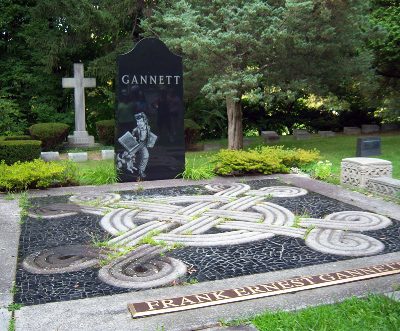
The Gannett family plot, Mount Hope Cemetery, Rochester NY

Six seasons of Visionaries in Motion

2006–07

Consilience: The Cognitive Revolution

The Gannett Project's first year hosted a high-profile lecture series on how ideas from evolution, artificial intelligence and neuroscience are changing our conception of what it means to be human. Starting in the 1960s, a growing number of cross-disciplinary thinkers had explored a bold new paradigm which located the social sciences and psychology within the larger network of scientific knowledge, drawing heavily on evolutionary thinking. The lectures ranged from family dynamics and the psychological differences between the sexes to the origins of the aesthetic sense and the adaptive functions of jealousy and depression.

In the words of first-year Gannett Board member and COS astrophysicist David Merritt: “As Dobzhansky once said, ‘Nothing in biology makes sense except in the light of evolution.’ And that applies equally to the human mind. The advances that have been made in evolutionary psychology are nothing short of revolutionary.”

Beginning with Dr. Eugenie Scott, a longtime activist in the creationism/evolution controversy, through capstone speaker Dr. Daniel Dennett, each of the seven speakers was known for research on the cusp of several different disciplines. The year also launched two new courses: “Truth & Consequences: Studies in Disciplinary Evidence” and “Cognitive Science: Interdisciplinary Negotiations,” in which students lunched with, interviewed, and videotaped each Gannett speaker.

2007–08

Visionaries in Motion

After a successful first year, reflected in growing attendance and a new “buzz” about the speakers, Professor Broe and the Advisory Board continued imagining new horizons for the project. A larger Advisory Board was tailored into a small Working Group with a second tier of “Consultants,” drawn from the community and across the Institute, who began over a year in advance to identify, research, and discuss each speaker.

The theme — “Visionaries in Motion” — framed “21st century thinkers and scholars in the arts, sciences and technology who ask the unasked questions.” The year began with PEN-award winning author, theoretical physicist and cosmologist Janna Levin, who spoke on “Minds, Machines and the Cosmos: Is the Universe Infinite?” and chaired a seminar for astrophysicists. It also included MacArthur-winning choreographer Elizabeth Streb, whose SLAM dancers (Streb Lab for Action Mechanics) blend physics, aesthetics and kinesics; a faculty colloquium on Patricia J. Williams; a seminar with new-media critic Ze Frank; and a closing workshop by novelist, playwright and cartoonist Lynda Barry drawn from her book What It Is.

2008–09

Visionaries in Motion III: The Human Imprint

The Gannett Project's reputation for bringing world-class creative speakers continued to grow. The year opened with legendary futurist and AI expert Ray Kurzweil, who drew a crowd of over 1,400 in the Gordon Field House for “The Singularity Is Near: When Humans Transcend Biology,” introduced by RIT President Bill Destler. An innovative three-quarter course, “Visionaries in Motion,” co-directed by Gary Skuse and Mary Lynn Broe, had students lunch with and videotape interviews with each Gannett guest.

The season paired Africadian poet George Elliott Clarke with NYC jazz pianist D.D. Jackson for “Be-Bopera”; brought environmental activist Bill McKibben (whose Deep Economy was RIT's freshman summer reading) to speak on “Uniting Global and Local”; hosted Canadian industrial-landscape photographer Edward Burtynsky; welcomed Mark Frauenfelder and Carla Sinclair of Boing Boing/Make/Craft; and closed with molecular biotechnologist Dr. Leroy Hood and Center for Land Use Interpretation director Matthew Coolidge.

2009–10

Named Best Lecture Series in Rochester by City Newspaper

Louverture Films producer Joslyn Barnes opened the year with “Imagination and the Cinema of Resistance,” paired with screenings of Bamako and Trouble the Water. Designer Stefan Sagmeister drew over 800 attendees across two auditoriums for “Design and Happiness” and issued a campus-wide design challenge that fourteen RIT classes took up. Rebecca Solnit spoke on “Other Loves”; astrophysicist Adam Frank on science and religion; artist Michael Singer on regenerative design; and webcomic creators Nicholas Gurewitch and Chris Onstad charmed younger audience members.

Pulitzer-winning journalist David Cay Johnston discussed “A Path Back to Prosperity for America”; MIT's Hiroshi Ishii presented “The Art of Tangible Bits”; and neuroscientist Christopher deCharms closed the year with real-time fMRI research. The season's original poster also lists religion scholar Reza Aslan speaking March 15, 2010 on “How to Win a Cosmic War” — a name that doesn't appear in the site's official alumni roster, so it's noted here rather than added to the Speaker Archive as fact.

City newspaper named Visionaries in Motion Best Lecture Series in Rochester in 2009 (Critics' Pick write-up, PDF), or see the original 2009–10 season poster (PDF).
2010–11

Sailing On

Another vibrant year opened with philosopher-mechanic Matt Crawford's workshop, “The Case for Working with Your Hands,” and closed capstone speaker behavioral economist Dan Ariely's “Who Put the Monkey in the Driver's Seat?” In between, the Gannett Project brought architect Jeanne Gang, graphic novelist Alison Bechdel, Eastman School composer David Liptak, experimentalist engineer Golan Levin, and storyteller Chimamanda Ngozi Adichie to campus, before ending in April with science writer and veterinarian David Bainbridge.

2011–12

Visionaries in Motion V — The Tradition Continues

The final season opened with an talk on DNA from National Medal of Science laureate Esther M. Conwell, followed by memoirist Ryan Knighton on writing after vision loss, and photography theorist Fred Ritchin on a world “after photography.” MacArthur Fellows Drew Berry (biomedical animation) and Elizabeth Turk (sculpture) joined MIT computational neuroscientist Sebastian Seung, cartoonist Charles Burns, and social-innovation writer David Bornstein to round out the year — the last before the series concluded. See the full 2011–12 lineup in the Speaker Archive, and the Open Letter announcing the project's conclusion.

The people behind the series

A larger group of colleagues and professionals — the Core Working Group plus a wider circle of Consultants — met throughout each year to identify speakers and shape the program.

Core Working Group

  • Mary Lynn BroeGannett Professor and Chair, Advisory Board, English, COLA
  • Susan LakinProfessor, School of Photographic Arts and Sciences, CIAS
  • Paul TymannProfessor and Chair of Computer Science, GCCIS
  • Linda RubelProfessor, NTID, COLA
  • Martha MorganAssistant Professor of Anthropology, COLA
  • Gary SkuseInterim Head, School of Biological & Medical Sciences; Professor of Biological Sciences
  • Christopher Tomkins-TinchStudent, Bioinformatics, COS; President, Make Club

National Consultant

  • Heather McHughMilliman Distinguished Writer-in-Residence, University of Washington

Consultants

  • Roberley BellFoundations, Studio and Art History, CIAS
  • Bleu CeaseExecutive Director / Curator, Rochester Contemporary Art Center
  • Robert ClarkFormer Dean, COS (ex officio)
  • Aaron Cripps2005 RIT Alumnus, School of Film and Animation, CIAS
  • Rebecca EdwardsHistory, COLA and President, Rochester Historical Society
  • Peter GabakAl Sigl Center; CIAS
  • Joe FlahertyExecutive Director, Writers & Books
  • Therese HanniganNew Media Design; President and Creative Director, Dumbwaiter Design
  • Vincent F. A. GolphinEnglish, COLA
  • Peter HauserResearch and Teacher Education, NTID and Director, Deaf Studies Laboratory
  • Ron JodoinProfessor, Physics, COS
  • Christine KeinerScience, Technology & Society, COLA
  • Peter Lazarski2005 RIT Alumnus, Graphic Design, CIAS
  • Catharine Mahrt-WashingtonAssistant Dean and Honors Advocate, COS
  • Joni MonroeExecutive Director, RRCDC
  • James MyersDirector, Center for Multidisciplinary Studies, CAST
  • Katherine SchumacherRet. Writing Director, Community Liaison
  • Marjorie SearlChief Curator, American Art, Memorial Art Gallery
  • V. Annie WroblewskiGannett Photographer

Design & Staff

  • Stephanie Kirschen ColeDesigner & Graphic Artist, 2006–2011
  • Matt DeTurckDesigner & Graphic Artist, 2011–2025
  • Chandni BhowmikStudent Assistant, MS, GCCIS