← Speaker Archive
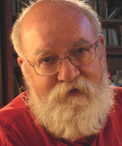
Daniel C. Dennett
University Professor, Professor of Philosophy, Co-director, Center for Cognitive Studies, Tufts University
University Professor, Professor of Philosophy, Co-director, Center for Cognitive Studies, Tufts University
Before Darwin, the only “explanation” of the wonderful design in the world — the functions of organs, the meaningfulness of words and of life itself, the ideal of morality — was “top-down”: basically a gift from God. Darwin's theory of natural selection showed the possibility of another kind of explanation, a “bottom-up” process that started with meaningless matter in motion, and built, by small, non-miraculous steps, up to life, function, purpose, meaning and even morality. Is Mind a recent evolved effect of this process or the original source of all meaning? No compromise seems possible, but if we free up our imaginations, we may be able to dissolve the conflict.
Daniel C. Dennett, author of Breaking the Spell: Religion as a Natural Phenomenon (Viking, 2006), Freedom Evolves (Viking Penguin, 2003) and Darwin's Dangerous Idea (Simon & Schuster, 1995; finalist for the National Book Award and the Pulitzer Prize), is University Professor and Austin B. Fletcher Professor of Philosophy, and Co-Director of the Center for Cognitive Studies at Tufts University. He lives with his wife in North Andover, Massachusetts, and has a daughter, a son, and a grandson. Born in Boston in 1942, he received his B.A. in philosophy from Harvard in 1963, then went to Oxford to work with Gilbert Ryle, completing his D.Phil. in philosophy in 1965. He taught at U.C. Irvine from 1965 to 1971, when he moved to Tufts, where he has taught ever since, aside from periods visiting at Harvard, Pittsburgh, Oxford, and the École Normale Supérieure in Paris.
His books include Content and Consciousness (1969), Brainstorms (1978), Elbow Room (1984), The Intentional Stance (1987), Consciousness Explained (1991), Darwin's Dangerous Idea (1995), Kinds of Minds (1996), and Brainchildren (1998); he co-edited The Mind's I with Douglas Hofstadter in 1981. He is the author of over two hundred scholarly articles on the mind, published in journals ranging from Artificial Intelligence and Behavioral and Brain Sciences to Poetics Today and the Journal of Aesthetics and Art Criticism.
He gave the John Locke Lectures at Oxford (1983), the Gavin David Young Lectures in Adelaide (1985), and the Tanner Lecture at Michigan (1986). He received two Guggenheim Fellowships, a Fulbright Fellowship, and a Fellowship at the Center for Advanced Studies in Behavioral Science, and was elected to the American Academy of Arts and Sciences in 1987. He co-founded (1985) and co-directed the Curricular Software Studio at Tufts, and helped design museum exhibits on computers for the Smithsonian Institution, the Museum of Science in Boston, and the Computer Museum in Boston.